The changes keep coming
If you thought the rise of perennial doormat Indiana to the top of the FBS mountain was the biggest change in college football, you would be wrong. Or, if you thought nothing could top the implications of NIL money and the portal – well, that would be wrong too. There’s something far bigger happening to U.S. academia and college football won’t be unscathed.
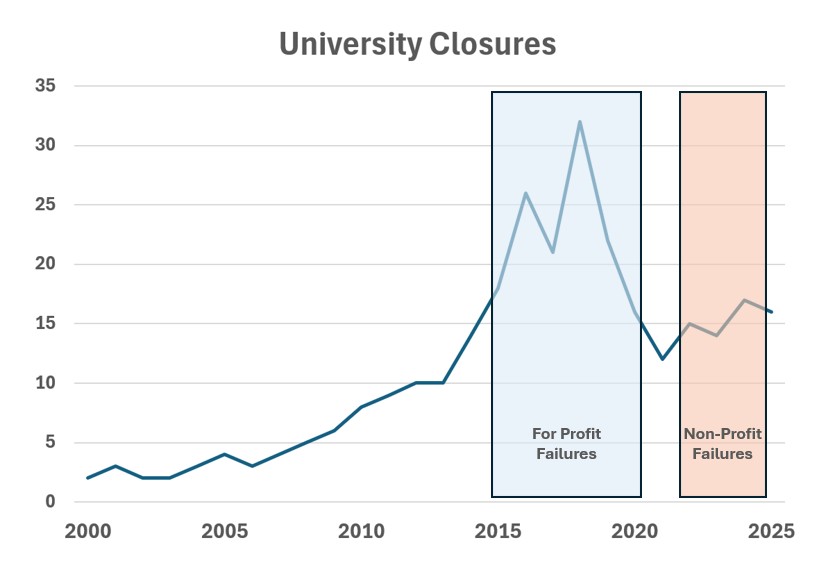
From 1996 to 2013, the U.S. averaged just three college closures per year. From 2014 through 2025, that average surged to ten closures annually. It is mostly private, liberal arts colleges for now, but smaller state schools are feeling the impact too. Demographic changes, challenges in FAFSA administration, and a reduced value proposition all lead to less students. If there was ever a list of endangered species for non-profits, small universities would be number one on the list. These schools are either disappearing or being gobbled up by larger university networks in alarming numbers. (Note – if you have kids going to college soon – think long and hard about the viability of the school and its current offering.)
Those that are hanging on are finding ways to cut costs such as reducing majors, cutting adjunct faculty, or eliminating sports programs. Last year, I saw Saint Francis University get drubbed by the University of Buffalo. The Friars wisely made the decision to drop from the FCS all the way down to Division III. The team I saw play didn’t look like they could beat eleven orphans even if you spotted them fourteen points and the ball. In addition to SFU’s move, five schools dropped football altogether.
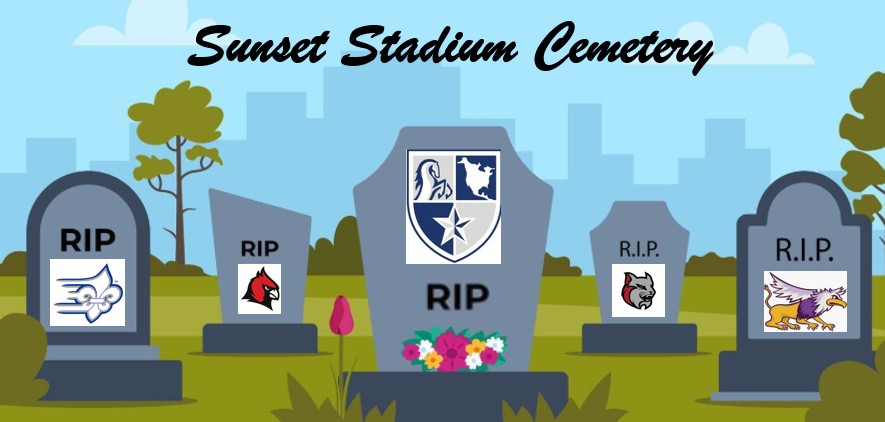
Alternatively, some schools seem to see football as a savior. As an example, Mercyhurst and Kennesaw State jumped to the FCS and FBS, respectively. These moves seem designed to increase name recognition rather than to extend their football prowess. The Lakers had a cumulative record of 204-222-4. Hardly, a program that has owned their competition. Other programs like NDSU and Sacramento State have dominated the FCS enough that their jump to the FBS seems at least somewhat justified. The grass, however, is not always greener on the other side.
I am sure the power point presentation that helped push the conference moves over the goal line had lots of positives. Expanded TV coverage, the Pop Tarts Bowl and increased enrollment as students flock to a reinvigorated campus. Reality can be a bit harsher. I have been to several programs where buyers’ remorse is as clear as the empty seats in the stands. Georgia Southern was an FCS power but since they have made the jump to the FBS, the game day experience has been slowly deteriorating. They still have plenty of traditions, but they don’t win as much. It doesn’t get cheaper for the fans either, as the move to the FBS brought higher ticket prices and more expensive tailgating options.
Even for successful jumpers like JMU, the move to the FBS hasn’t proved as fruitful as thought. Of course, they made the College Football Playoff last year. The Dukes can spin their 28 point second half however they want, the harsh reality was that the game was over when the first half ended 34-6 Oregon. As good as JMU was last year, they still looked like they didn’t belong. It wasn’t like they couldn’t get big wins as an FCS team, having beaten both Virginia and Virginia Tech back in the day.
The real challenge is how any lower FBS team will be able to compete. In a world where the powerhouse teams are going to continue to pick up more student dollars from the failing small schools, their NIL and portal advantage will only grow. Indiana had a donor base (including John Mellencamp, Uh-huh) that allowed for a massive turnaround. It won’t be as easy for an FCS program to rise to that level, if ever.
In the larger scheme of things, the disparity of the “have’s” and “have nots” of the FBS is likely to only get worse. I suppose there is an opportunity for an FCS program to capitalize on the impending tide of small school failures, but they too will have to contend with a declining population of students.
From a fan’s perspective, the Power Five experience will feel even more “pro” like than it already does. Although one wonders if schools like Northwestern, Duke, Stanford, and Vanderbilt will try to compete in that environment. I can envision a split FBS, where you have FBS-I and FBS-II. Conferences will change again, rivalries and traditions will go to the wayside, and it will get more and more corporate. I am going to enjoy the next couple of years. You should too.
A month to go until kickoff
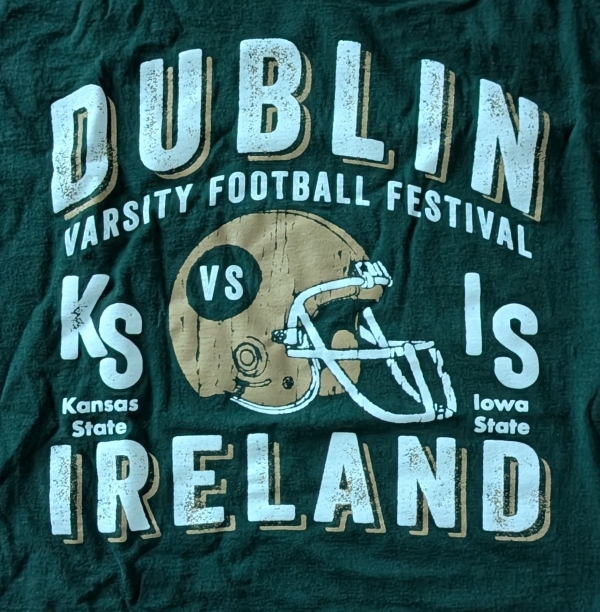
The season opens up in Dublin, Ireland on August 29th when North Carolina takes on TCU. I can’t say how the NCAA does at putting on these games, but if they are half as good as the NFL, Tar Heel and Horned Frog fans should have a great time. We had a blast in Dublin for the Steeler game last year. I also managed to snag some clearly, non-licensed merchandise from last years’s game between Kansas State and Iowa State. Admittedly, not the sharpest looking shirt, but at ten euros, I couldn’t resist picking it up when I saw how un-authentic it looked.
Tree